How to Price Paintball Packages at Your Venue
Most paintball venue owners get their pricing wrong in one of two directions. They either charge so little that a busy weekend barely covers the field's costs, or they build a confusing rate sheet with so many options that customers abandon the booking page before they pick anything.
Pricing paintball packages is not complicated once you understand what you are actually selling and who is buying it. This guide walks through how to think about your package structure, what to charge for, and where operators most often leave money on the table.
What Customers Are Actually Buying
When someone books a paintball session, they are not buying access to a field. They are buying a defined experience — a length of time, a guaranteed number of shots, and the feeling that they got a fair deal before the day even starts.
That framing matters for pricing because it tells you where the value is. A group of twelve people celebrating a birthday is not price-shopping the way a pair of walk-ins on a Tuesday might be. They want clarity, they want a number they can share with the group in a text message, and they want to know what is included so nobody is surprised at checkout.
Build your packages around the experience, not around your cost structure. Customers do not care how much paint costs you wholesale. They care whether the package feels worth it for the time they are spending.
Start with Your Core Session Tiers
Most venues run best with two or three session packages at the base level. More than three creates decision paralysis. Fewer than two makes it hard to serve different group sizes and budgets.
A common and effective structure looks like this:
- Entry package — a shorter session, lower paint count, entry price point. Works for smaller groups, first-timers, or customers on a tighter budget. This is your foot-in-the-door option.
- Standard package — your main offering. Longer session, more paint, enough time to play multiple rounds. This should be the package the majority of your bookings land on.
- Premium or party package — designed for groups, birthdays, corporate outings, or anyone who wants a full experience with extras included. Higher price, higher perceived value.
Each tier should have a clear reason to step up to the next one. If the difference between your entry and standard package is only 50 extra paintballs, the step-up does not feel worth it. Make the gap meaningful — more time, more paint, or something concrete like a private field reservation or a dedicated ref.
How to Set the Numbers
There is no universal right answer for what a paintball package should cost. Rates vary significantly by region, facility size, and what is included. That said, there are a few anchors to work from.
Know your floor. Add up the real cost of running a session: paint, CO2 or air, staff time, equipment wear, and a portion of fixed overhead per booking. That is your floor — the number you cannot go below without losing money on the booking itself. Most operators underestimate this because they forget to factor in equipment depreciation and the labor cost of checking in, suiting up, and managing a group through a game.
Look at what the market is doing locally. Search for paintball venues in your area and see what they charge for comparable packages. You do not need to be the cheapest option, but you should understand the range your customers are comparing you against before they click away.
Price toward the premium end of what feels reasonable. Paintball is a physical, high-energy experience that most people do a few times a year at most. It is not a commodity. Operators who price like a commodity — racing to match the lowest rate around — often find that they are busy but not profitable. Price for the experience, not for the market floor.
Test your packages in groups of people who have not been to your venue. Show them the package names, descriptions, and prices without context and ask what they would pick. You will learn quickly whether the naming is confusing, whether the value jump between tiers makes sense, and whether the price feels right or feels like a gamble.
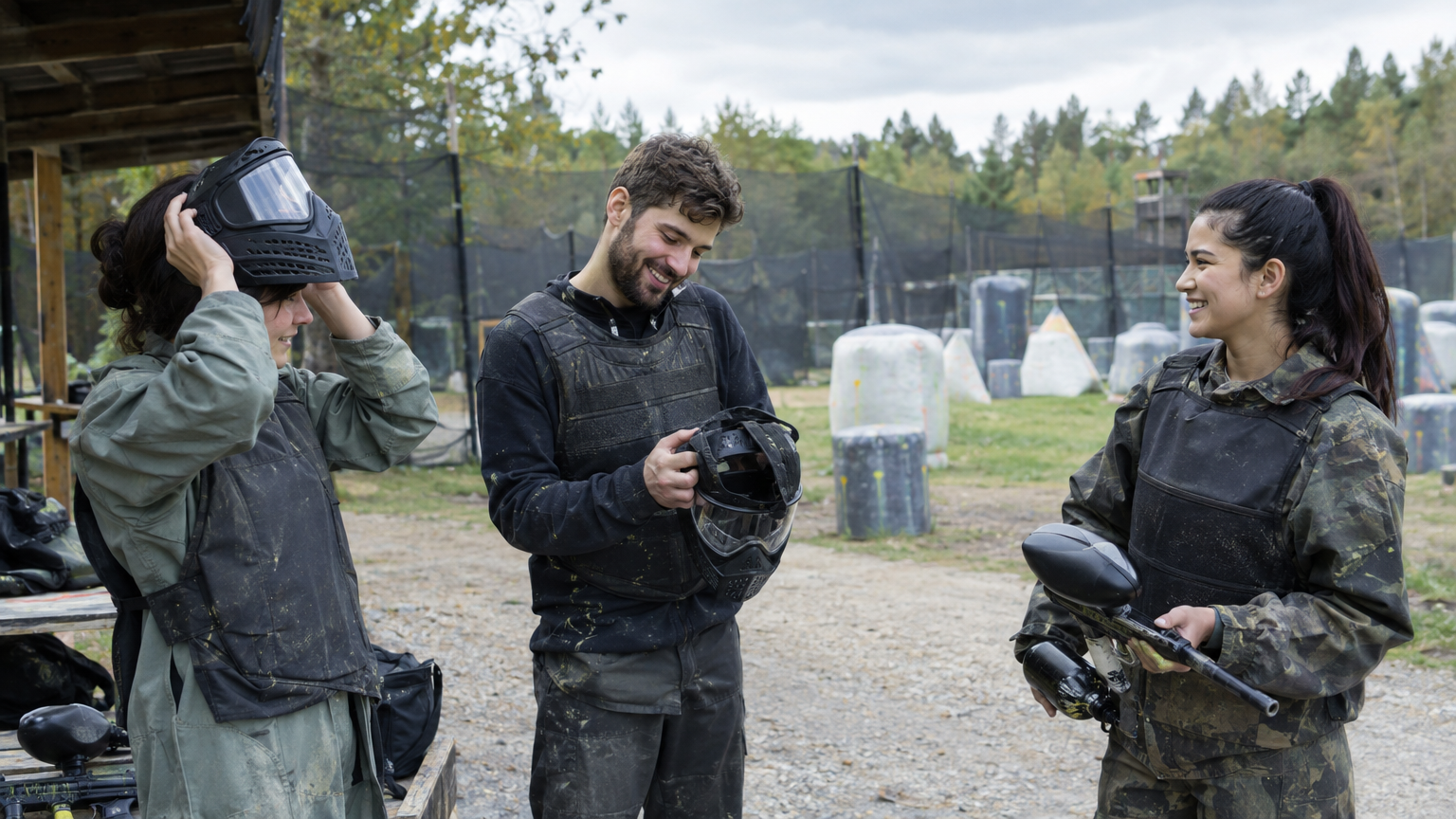
Groups want to feel set up for a good time before they step on the field — clear packages and included gear help deliver that.
Group Pricing: Where the Revenue Actually Is
Walk-ins are nice. Groups are what build a paintball business.
Birthday parties, bachelor and bachelorette groups, corporate team days, school outings, church youth groups — these are the bookings that fill a field for three or four hours on a Saturday and generate real revenue in a single transaction. They also tend to repeat when the experience is good, because the organizer becomes the person their circle calls when they need an activity.
For groups, a per-person rate usually works better than a flat package price. It gives the organizer a number they can multiply out themselves, and it scales naturally as the group grows. Set a minimum headcount — somewhere between six and ten players is common — so you are not dedicating field time and staff to three people at a group rate.
Consider a separate group deposit to hold the date. A group that books without leaving money down is a group that cancels at the last minute when plans change. A deposit ties them to the commitment and protects the time you blocked off for them.
Private field add-on
For groups that want exclusivity — no strangers, no public sessions running alongside them — offer a private field option at a premium. This is one of the easiest add-ons to price because the value is obvious to the customer and the operational cost is just holding that field off general availability for the session window. Many groups will pay meaningfully more for the guarantee that it is just their crew on the field.
Add-Ons That Actually Sell
Add-ons work best when they feel natural at checkout — when a customer is already saying yes to the experience and the add-on is the obvious next step, not an afterthought buried at the bottom of the booking form.
The add-ons that tend to move at paintball venues:
- Extra paint — the most obvious one. Offer bundles rather than per-ball pricing so it feels like a deal and reduces the awkwardness of customers counting shots.
- Equipment upgrades — better mask, upgraded marker, or a rental package for customers who want to show up empty-handed and shoot better gear.
- Referee or game guide — for groups that want a more structured, hosted experience rather than running their own games. This is especially popular with corporate groups and birthday parties where the organizer wants to be a participant, not a coordinator.
- Food and drinks — if your facility allows it, a snack or food package sold through checkout is easy revenue and makes the logistics easier for groups.
- Spectator passes — some venues charge a small entry fee for non-playing guests who want to watch. This is worth testing if you host a lot of birthday parties where parents accompany younger players.
Put your add-ons in front of customers while they are completing the booking, not after. By the time someone has selected a package and entered their info, they are committed to the experience. That is the right moment to offer paint upgrades and extras — not in a follow-up email two days later.
Rain Checks and Cancellation Policy
Weather closes outdoor fields. Groups cancel. These situations are guaranteed to happen, and how you handle them has a direct effect on whether that booking becomes future revenue or a chargeback dispute.
A clear rain check policy protects you and reassures the customer. When you cancel due to weather, issue a rain check for the full value of what they paid — not a refund, not a credit that expires in two weeks, but a genuine rain check they can use on any future visit. This keeps the money in your business and gives the group a reason to come back.
For customer cancellations, set a window that is reasonable but real. Cancellations more than 72 hours out might get a full credit. Inside 48 hours, the deposit is non-refundable. These terms should be visible before checkout and confirmed at booking, not buried in a confirmation email nobody reads before a problem happens.
How Your Booking System Affects What You Can Charge
There is a practical connection between your pricing structure and how you collect money that operators often miss. If your booking system makes it hard to set per-person pricing, minimum headcounts, or deposit rules, you will eventually simplify your pricing just to make the workflow manageable. And simpler pricing usually means leaving revenue on the table.
When your platform lets you set package prices with base player counts, extra-player fees, and deposit percentages in one place, it is much easier to run the tiered group pricing model that actually moves revenue. You can also offer private field options as a toggle or an add-on rather than managing it manually through calls and emails.
VrixPlay's paintball setup is built around this model. You define packages with base pricing, min and max player counts, extra player fees, and included items. Add-ons sell inside checkout. Waivers are tied to every booking automatically, so no one steps on the field without a signature. And you can issue rain checks without making customers wait for a refund to clear.
If you want to see how the package builder works before committing to anything, explore the paintball features — setup takes about fifteen minutes and there is no monthly fee.
Common Pricing Mistakes to Avoid
Charging the same rate for every group size. A group of eight and a group of twenty-five are very different operational commitments. Your pricing should reflect that difference through minimums, per-person rates, and field allocation.
Pricing paint too low. Paint is often where the real margin lives, and many venues underprice it because it feels like a commodity. If you sell paint at cost or near it, you are essentially giving away the thing customers go through the most. Price paint add-ons with healthy margin.
Too many package options. Five or six packages with overlapping features will confuse customers and push them toward choosing nothing. Three clean tiers with clear differentiation will convert better than a detailed menu of every possible combination.
No deposit on group bookings. Groups without deposits cancel. This is not occasional — it is predictable. Protecting your schedule with even a partial deposit up front changes the cancellation rate significantly.
Never updating your pricing. If your rates have not changed in two or three years, they are almost certainly too low. Review your pricing at least once a season and adjust for any cost increases in paint, staffing, or facilities.
Putting It Together
Good paintball package pricing is not about finding the lowest number that still gets bookings. It is about building a structure that makes the value obvious at every tier, gives groups a clear path to a great day, and protects your operation from the cancellations and undersells that chip away at a busy season.
Start with two or three core packages, set group rates with minimums, price your add-ons to move at checkout, and make sure your rain check and cancellation policies are visible before anyone hits confirm. That foundation will hold up across a full season without constant adjustment.
If you are setting up or rebuilding your booking flow, VrixPlay's paintball platform is free to start — $0 per month, 3% per booking, with setup handled by the team in Destin.
