
How to Set Up Recurring Departures for Your Tour Boat (and Never Oversell a Seat Again)
Most tour boat and cruise operators start with the same informal system: a shared calendar, a phone number on the website, and someone manually tracking who paid. That works fine when you run three or four trips a week. It breaks down fast when you add a second vessel, a second departure time, and a booking link on a third-party listing site.
The result is the problem almost every growing tour operation hits at some point: seats sold in more places than your headcount can actually support. You count heads at the gangway and the math does not add up. Or you go the other direction and leave the boat half full because you could not see what was already sold elsewhere.
Setting up a real recurring departure schedule — one that enforces capacity, shows availability in real time, and handles ticketing automatically — is one of the highest-leverage moves a tour boat operator can make. Here is how it works in practice.
Why ad hoc scheduling creates real problems at scale
When you manage departures manually, every booking decision lives in someone's head or inbox. A walk-in at the dock, a DM on Instagram, a phone call, and an online form all funnel into the same mental calendar. Capacity tracking happens at boarding, not at checkout.
That creates a few specific failure modes:
- Overselling. Two guests buy the last two available seats through different channels at the same time. Neither channel knows the other exists.
- Underreporting. You turn away phone inquiries on dates that still had room because the person managing calls was not sure what was actually available.
- Manual reminder fatigue. Typing arrival instructions and parking details to each booking, one at a time, every day.
- No data. At the end of the season, you do not know which departure times filled reliably and which should be cut or moved.
None of these are signs of a bad operation. They are signs of a scheduling system that was not built for what the business has grown into.
What a recurring departure schedule actually looks like
The concept is straightforward: you build your weekly schedule once — Monday dolphin cruise at 10am, sunset sail at 6pm, Saturday snorkel trip at 9am — and the system publishes those departures automatically on a rolling basis. Guests see real-time availability and buy tickets online. Capacity is enforced at checkout, not on the dock.
Each departure carries its own seat inventory. When a ticket sells, that seat count decrements in real time across every channel selling from the same inventory. There is no reconciling at boarding because the reconciling already happened.
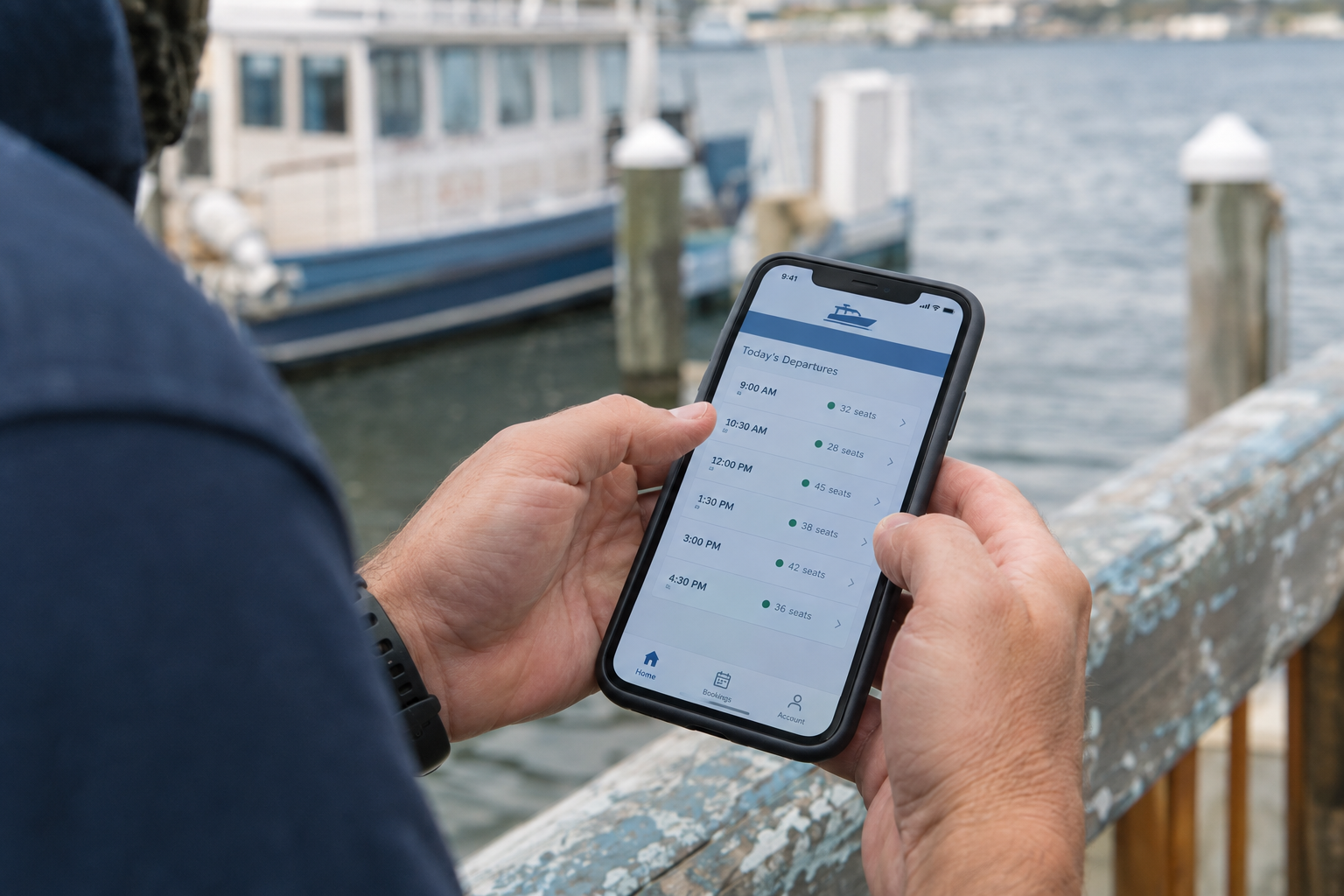
From the operator side, this means your dashboard shows every upcoming departure, how many seats are sold, how many remain, and which guests have paid. You are not guessing. You are reading a number.
Adult, child, and senior pricing without the spreadsheet
Tour boats almost always run multiple ticket types. A dolphin cruise might sell adult tickets at $45, kids at $25, and senior pricing at $38. When you manage this in a spreadsheet or through a booking form, you are constantly recalculating totals and confirming whether the right tier was applied.
A ticketing system built for per-seat departures handles this at the checkout level. The guest selects how many adults, how many children, how many seniors. The system calculates the total, collects payment, and issues a confirmation with a QR boarding pass — all without a single email from your team.
That confirmation includes the departure time, arrival instructions, parking details, and whatever else you want guests to know before they show up. You write it once and it goes out every time a ticket sells.
QR boarding: what actually changes at the dock
Paper tickets and headcounts at the gangway are one of those things operators tolerate for years because the alternative seems complicated. In practice, switching to QR boarding passes is one of the simpler changes in the whole operation.
When a guest books, they get a confirmation with a QR code. On departure day, a crew member scans codes from their phone as guests walk up. The system checks the guest off the manifest in real time. When boarding is done, the manifest is closed and accurate — headcount, names, waiver status — without anyone writing anything down.
For operators running multiple boats or multiple departure points, this is particularly useful. Every vessel has its own manifest, accessible from any phone on your team. There is no calling the office to verify who is on which boat.
Handling weather cancellations without the phone tree
Canceling a departure for weather is a task that used to take twenty minutes of calls and texts. With a departure-based system, it takes about thirty seconds. You cancel the departure from your dashboard, every ticket holder gets notified automatically, and you either issue refunds from the same screen or rebook guests onto the next available date.
This matters more than most operators realize. Guests who get a clear, fast communication about a cancellation — with an easy path to reschedule or get a refund — come back. Guests who find out at the dock do not.
Building the schedule: where to start
The most common mistake tour operators make when setting up recurring departures is trying to mirror their current ad hoc system exactly. Every exception, every one-off pricing tier, every special arrangement becomes a parameter in the new setup. The result is a configuration that takes weeks and satisfies no one.
A better approach: start with your core weekly schedule and standard pricing, get that running, and handle exceptions as they come up. For most operations, the core schedule is two to four departure times per day, two ticket types (adult and child), and a standard capacity per vessel. That can be set up and live in an afternoon.
Private bookings and group charters can sit beside recurring public departures in the same calendar. When a private hire blocks a date, those seats are unavailable for online ticketing. The calendar shows the full picture — public, private, and blocked — in one view.
What load factor data actually tells you
Once you are running on a proper departure schedule, you start accumulating data that is genuinely useful for next season's planning. Load factor — how many seats you filled versus how many were available — tells you which time slots are worth keeping and which are not.
A 10am dolphin cruise that runs at 80 percent capacity every weekend is worth protecting. A 2pm Tuesday departure that consistently goes out half full might be better converted to a private-hire-only slot, or dropped from the recurring schedule entirely. You cannot make that call without numbers, and you cannot get the numbers from a shared calendar and a notebook.
Running multiple boats from one login
For operators with more than one vessel or more than one departure point, managing separate systems for each boat is the kind of overhead that burns hours every week. A single dashboard that shows all boats, all departures, and all sold inventory — with role-based access so crew members only see what they need — is the operational difference between running a fleet and managing chaos.
Crew members get a focused view: their boat, their departure, their manifest. Owners and admins see everything. Nobody is logging into three different places to figure out what the day looks like.
The short version
Recurring departure scheduling is not a luxury for big tour operations. It is the baseline that prevents overselling, makes boarding faster, cuts the manual reminder workload, and gives you data to actually improve the schedule over time. You build it once. It runs every week.
VrixPlay is free to use, with a flat 3 percent per booking. It is built for exactly this kind of operation — dolphin cruises, sunset sails, snorkel trips, sightseeing tours — and handles ticketing, boarding, waivers, reminders, and weather cancellations in one place. If you are still managing departures by hand, it is worth a look.
